Associate professor, Department of Jurisprudence and Fundamentals of Islamic Law, Central Tehran Branch, Islamic Azad University, Tehran, Iran.
10.22034/jatj.2026.594560.1106
Abstract
The Ahl al-Bayt (as) possess such an elevated status that, according to both Shia and Sunni sources, comparing others with them is impossible and explicitly prohibited by traditions (Aḥādith). Due to this incomparability, specific jurisprudential rulings distinguish them from the Ummah. These include: their Wilāyah being a condition for faith and accepting deeds; invoking blessings (Ṣalawāt) upon them in prayer; the prohibition of receiving charity (Ṣadaqah); the exclusive allocation of Khums and Anfal; the prohibition of entering their presence in ritual impurity; and the death penalty for insulting them (Sabb). This incomparability is founded on their unique position in the ontological order (Niẓām al-Takwīn). Consequently, recognizing these epistemological foundations is necessary to conceptually accept these premises. The most significant foundations for their incomparability include being the proofs of Allah (Ḥujaj Allah), possessors of divine rulings, absolute vicegerents (Khalīfah al-Tammah), manifestations of Allah’s supreme attributes, and intermediaries of grace (Wasā’it al-Fayḍ). Furthermore, the Ahl al-Bayt serve as the exact equivalent to the Messenger of Allah, the speaking Qur’an (Qur’an al-Natiq), and Allah’s most proximate chosen servants.
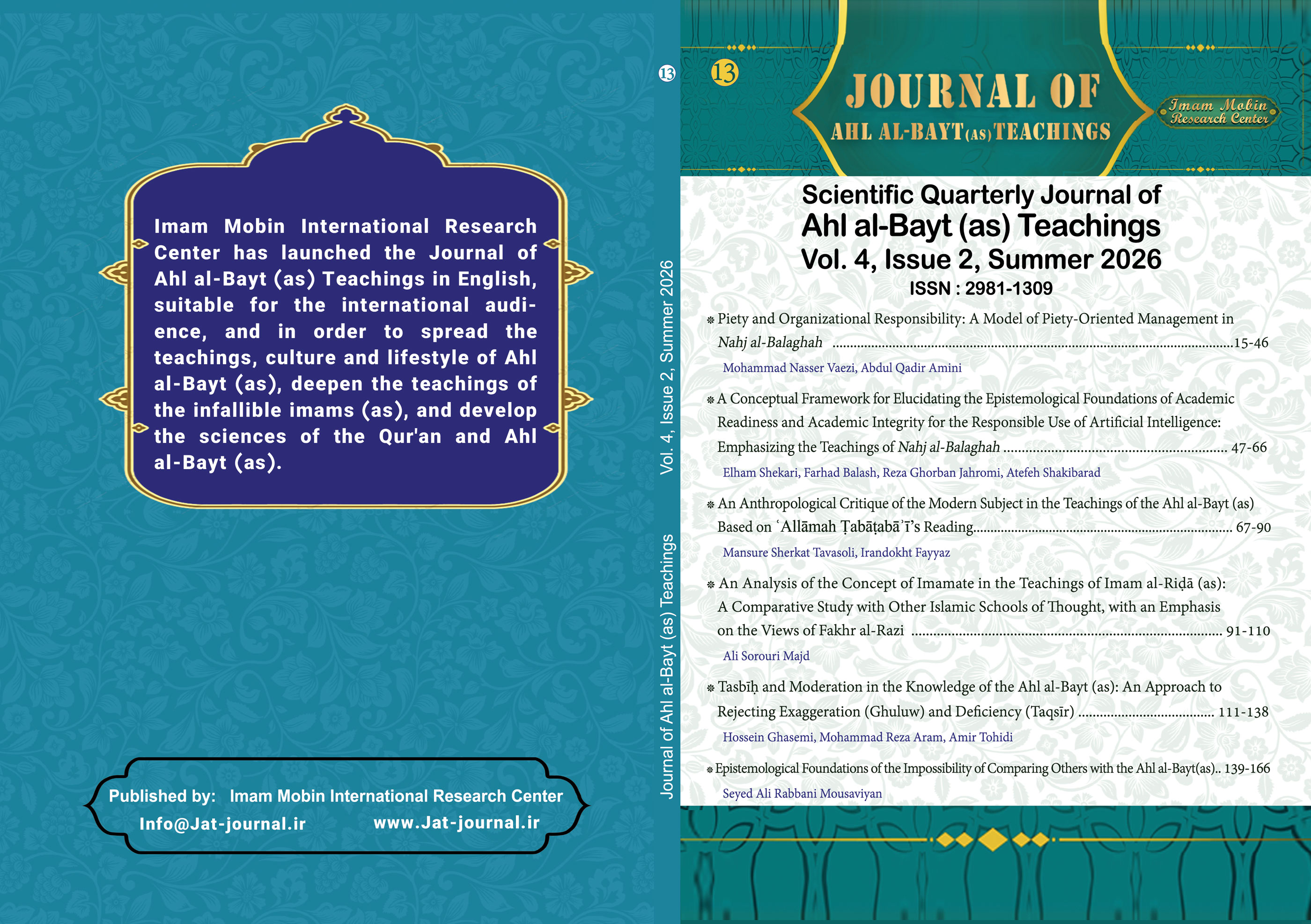
Rabbani Mousaviyan, S. A. (2026). Epistemological Foundations of the Impossibility of Comparing Others with the Ahl al-Bayt (as). Ahl al-Bayt (as) Teachings, 4(2), 139-166. https://doi.org/10.22034/jatj.2026.594560.1106
MLA
Rabbani Mousaviyan, S. A. "Epistemological Foundations of the Impossibility of Comparing Others with the Ahl al-Bayt (as)", Ahl al-Bayt (as) Teachings, 4, 2, 2026, 139-166. doi: 10.22034/jatj.2026.594560.1106
HARVARD
Rabbani Mousaviyan S. A. (2026). 'Epistemological Foundations of the Impossibility of Comparing Others with the Ahl al-Bayt (as)', Ahl al-Bayt (as) Teachings, 4(2), pp. 139-166. doi: 10.22034/jatj.2026.594560.1106
CHICAGO
S. A. Rabbani Mousaviyan, "Epistemological Foundations of the Impossibility of Comparing Others with the Ahl al-Bayt (as)," Ahl al-Bayt (as) Teachings, 4 2 (2026): 139-166, doi: 10.22034/jatj.2026.594560.1106
VANCOUVER
Rabbani Mousaviyan S. A. Epistemological Foundations of the Impossibility of Comparing Others with the Ahl al-Bayt (as). Ahl al-Bayt (as) Teachings. 2026;4(2):139-166. doi: 10.22034/jatj.2026.594560.1106