Ahl al-Bayt (as) Teachings

Ahl al-Bayt (as) Teachings

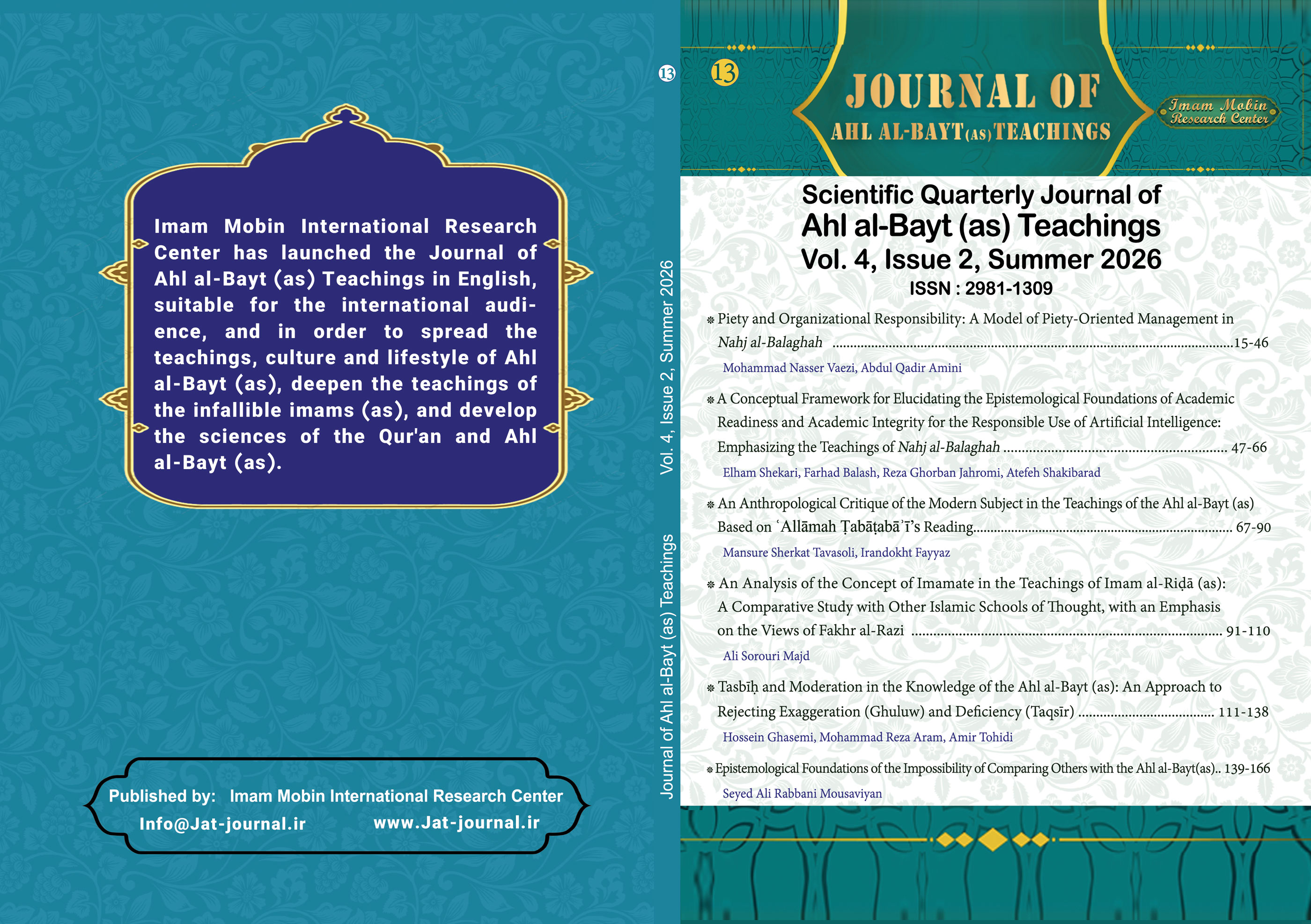
An Analysis of the Concept of Imamate in the Teachings of Imam al-Riḍā (as): A Comparative Study with Other Islamic Schools of Thought, with an Emphasis on the Views of Fakhr al-Razi

Document Type : Original Article

Author
Assistant Professor, Research Institute of Culture, Art and Communication (RICA)
10.22034/jatj.2026.597505.1113
Abstract
The lineage of Imams begins with Prophet Ibrahim (as), whose attainment of this exalted station following multiple divine trials is explicitly stated in verse 124 of Surah al-Baqarah. Subsequently, this station was granted to other distinguished and specific figures. During the era of Imam al-Riḍā (as), the analysis of the meaning and nature of Imamate was a critical subject of debate, particularly as it was frequently conflated with the common notion of “Caliphate” among non-Shi’a scholars. The central question of this article is: How is the station and concept of Imamate analyzed in the teachings of the Ahl al-Bayt (as), particularly Imam al-Riḍā (as), and what is its fundamental distinction from the perspectives of other Islamic schools of thought? In addition to the Qur’an and the traditions of the Ahl al-Bayt (as), this study focuses on Tafsir al-Mizan as a representative of Shi’a exegesis, and Fakhr al-Razi’s Mafatih al-Ghayb as a representative of Sunni exegesis. Within Shi’a thought, it is argued that the term “Imam” in verse 124 of Surah al-Baqarah denotes a station distinct from prophethood, as it was granted to Prophet Ibrahim (as) in his old age—a time when he had already attained the station of prophethood; thus, a redundant conferral of prophethood is logically untenable. Conversely, Fakhr al-Razi and certain other Sunni exegetes insist that the term “Imam” refers to the station of prophethood itself, enjoyed by all prophets. This article, written using a descriptive-analytical method and based on documentary research, concludes that the “Imam” referenced in the Qur’anic verse and the teachings of the Infallibles (as)—with an emphasis on the discourses of Imam Riḍā (as)—possesses a station superior to that of prophethood. This station is characterized by wilāyah (divine authority), ‘ismah (infallibility), and divine knowledge.
Keywords
Subjects

Volume 4, Issue 2
Summer 2026
Pages 91-110

  • Receive Date 16 August 2026
  • Accept Date 23 September 2026
  • First Publish Date 23 September 2026
  • Publish Date 01 September 2026