1
Department of Islamic Studies, Faculty Member of Imam Mobin Research Center, Qom, Iran.
2
Department of Arabic Conversation, Higher Education Complex for Language, Literature and Culturology, Al-Mustafa International University, Qom, Iran.
10.22034/jatj.2026.587215.1098
Abstract
This study examines the concept of organizational piety within the framework of Islamic management, with a specific focus on Nahj al-Balaghah, and aims to develop an operational model of responsibility for contemporary organizations. The central research question is: How can the principle of piety (Taqwá), as articulated in Nahj al-Balaghah, be conceptualized and operationalized as an internal control mechanism? Employing an analytical–interpretive methodology, the research draws on the sermons, letters, and wisdoms attributed to Imam Ali (as). Textual units were selected through purposive sampling based on their explicit relevance to governance, ethics, and responsibility; they were then coded, categorized, and synthesized into core dimensions and finally into a proposed management model. The findings demonstrate that piety in Imam Ali's intellectual system extends beyond a personal moral virtue and functions as an internal control mechanism that elevates organizational responsibility from a contractual obligation to a divinely oriented commitment. Based on this foundation, the article identifies seven core pillars of taqwá based organizational responsibility: justice orientation; transparency and accountability; participation and consultation; prioritization of the public interest; respect for human dignity; long term thinking and sustainability; and attention to knowledge and wisdom. Building on these elements, the study proposes a piety oriented management model. The article concludes by outlining key implementation challenges and offering practical strategies for institutionalizing this model within today's organizations.
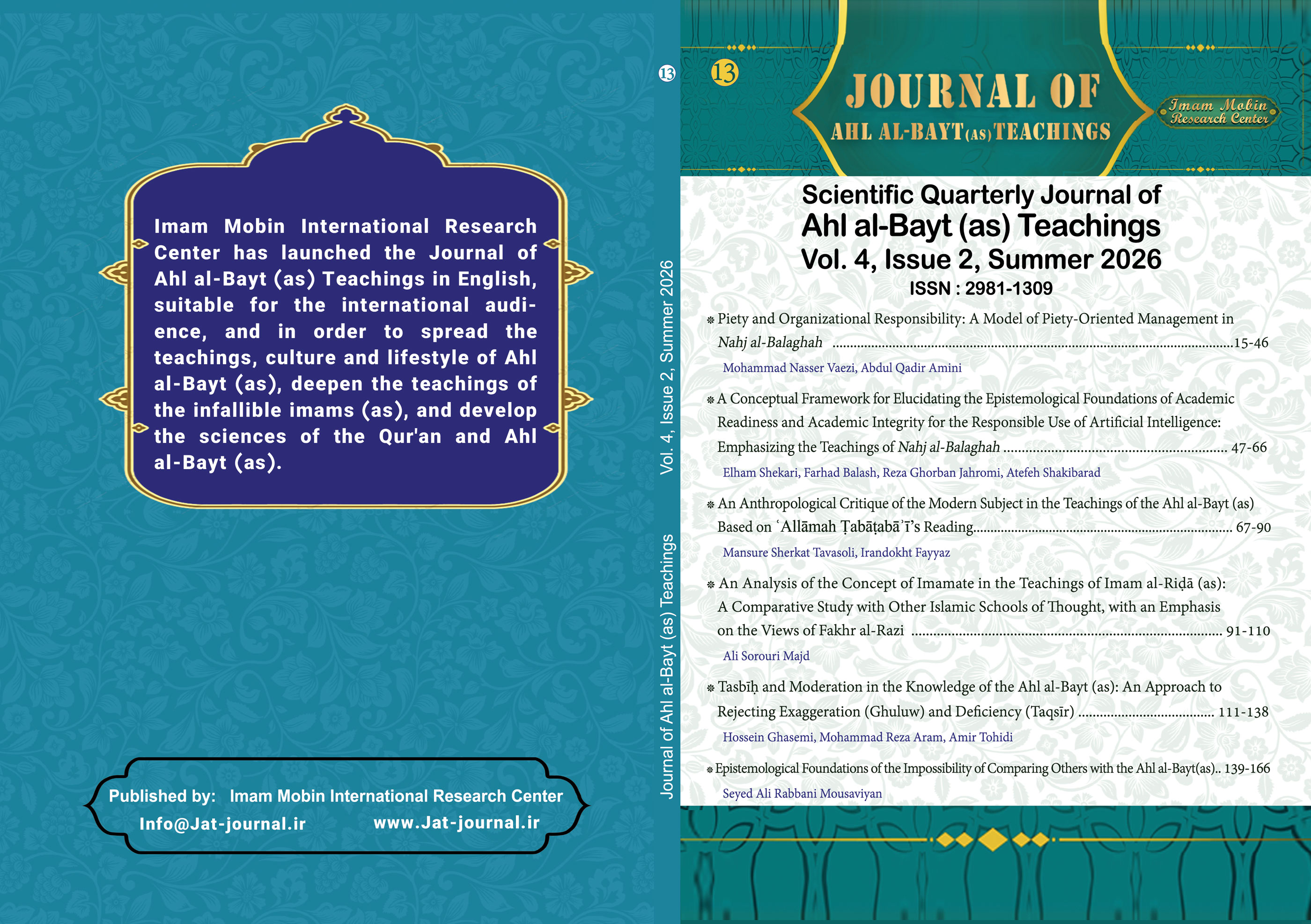
Vaezi, M. N. & Amini, A. Q. (2026). Piety and Organizational Responsibility: A Model of Piety-Oriented Management in Nahj al-Balaghah. Ahl al-Bayt (as) Teachings, 4(2), 15-46. https://doi.org/10.22034/jatj.2026.587215.1098
MLA
Vaezi, M. N., & Amini, A. Q. "Piety and Organizational Responsibility: A Model of Piety-Oriented Management in Nahj al-Balaghah", Ahl al-Bayt (as) Teachings, 4, 2, 2026, 15-46. doi: 10.22034/jatj.2026.587215.1098
HARVARD
Vaezi M. N., Amini A. Q. (2026). 'Piety and Organizational Responsibility: A Model of Piety-Oriented Management in Nahj al-Balaghah', Ahl al-Bayt (as) Teachings, 4(2), pp. 15-46. doi: 10.22034/jatj.2026.587215.1098
CHICAGO
M. N. Vaezi & A. Q. Amini, "Piety and Organizational Responsibility: A Model of Piety-Oriented Management in Nahj al-Balaghah," Ahl al-Bayt (as) Teachings, 4 2 (2026): 15-46, doi: 10.22034/jatj.2026.587215.1098
VANCOUVER
Vaezi M. N., Amini A. Q. Piety and Organizational Responsibility: A Model of Piety-Oriented Management in Nahj al-Balaghah. Ahl al-Bayt (as) Teachings. 2026;4(2):15-46. doi: 10.22034/jatj.2026.587215.1098