The term esoteric interpretation or ta’wīl has an important place in Islamic tradition, especially in Qur'anic commentary and mysticism, but also in other religious disciplines, such as dogmatic theology, principles of jurisprudence, jurisprudence, and philosophy. When esoteric interpretation is used in connection with the Qur’an, it is applied to all levels of meaning, from a simple, literal meaning to the hidden meanings. In the exegetical traditions, ta’wīl is mostly applied to the hidden meanings and esoteric exemplars of Qur’anic words. A major goal of this research on the history of esoteric interpretation is, to compare and contrast the methods employed in various texts belonging to the esoteric tradition of Qur’anic interpretation in the fourth century with a view to understand what, if anything, they all had in common. In order to do this, the study will document all major ta’wīl works that were produced in Shi'i Islam in the fourth century, the century which has been known as the establishment of the traditional Shi‘i school of exegesis. Based on the above, the main topics of this research revolves around three axes: Definition of esoteric interpretation, methodology of Shiite Islam in esoteric interpretation of Qur’an and the examples of ta’wīl in classical Tafsīr works of Twelver Shia in the fourth century including Tafsīr Ali ibn ibrahim Al-Qomi", Tafsīr Furat Kufi, Tafsīr Nu’māni, and The Commentary Attributed to Imam al-‘Askarī.
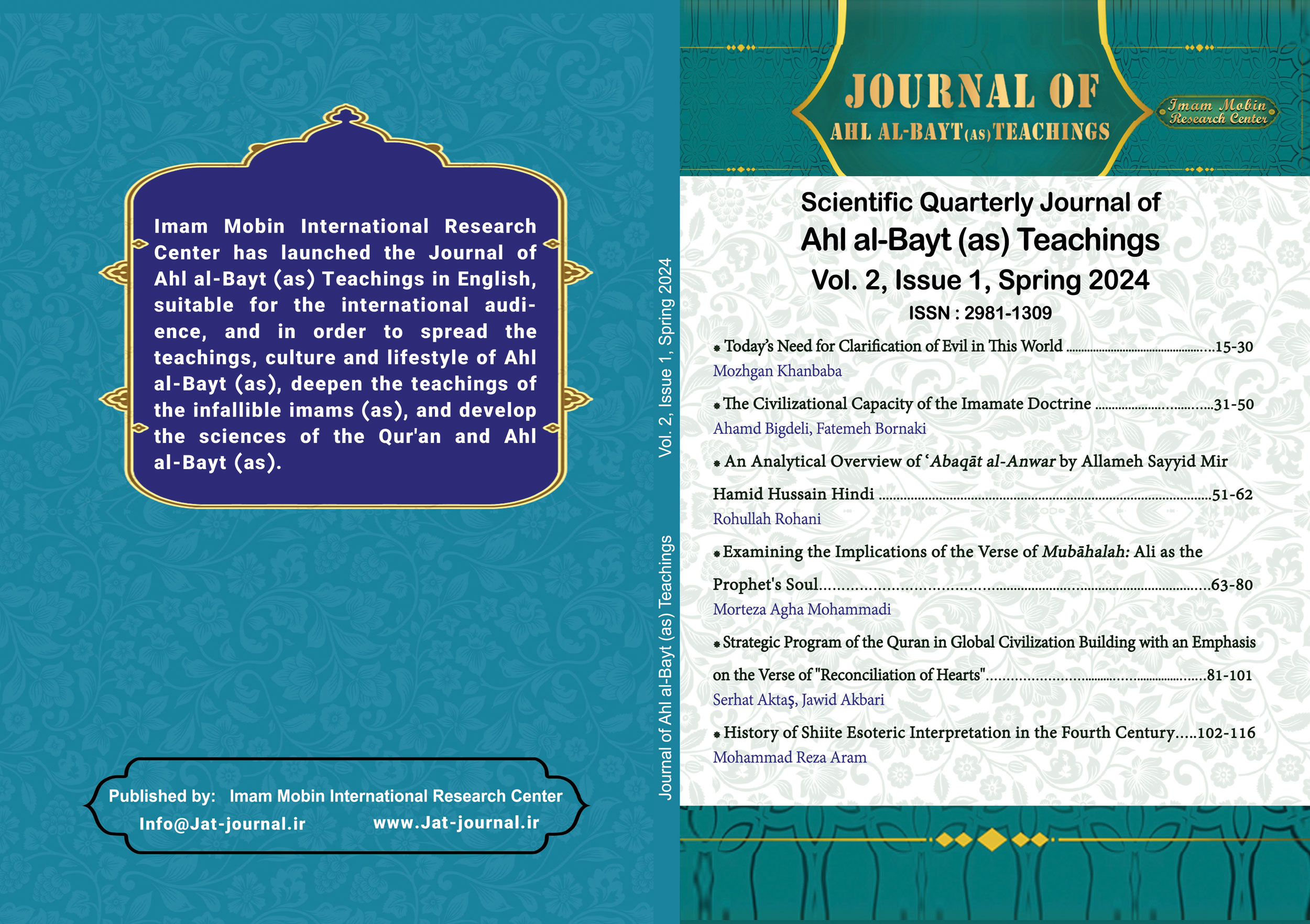
Aram, M. R. (2024). History of Shiite Esoteric Interpretation in the Fourth Century. Ahl al-Bayt (as) Teachings, 2(1), 102-116. https://doi.org/10.22034/jatj.2024.488538.1028
MLA
Aram, M. R. "History of Shiite Esoteric Interpretation in the Fourth Century", Ahl al-Bayt (as) Teachings, 2, 1, 2024, 102-116. doi: 10.22034/jatj.2024.488538.1028
HARVARD
Aram M. R. (2024). 'History of Shiite Esoteric Interpretation in the Fourth Century', Ahl al-Bayt (as) Teachings, 2(1), pp. 102-116. doi: 10.22034/jatj.2024.488538.1028
CHICAGO
M. R. Aram, "History of Shiite Esoteric Interpretation in the Fourth Century," Ahl al-Bayt (as) Teachings, 2 1 (2024): 102-116, doi: 10.22034/jatj.2024.488538.1028
VANCOUVER
Aram M. R. History of Shiite Esoteric Interpretation in the Fourth Century. Ahl al-Bayt (as) Teachings. 2024;2(1):102-116. doi: 10.22034/jatj.2024.488538.1028